
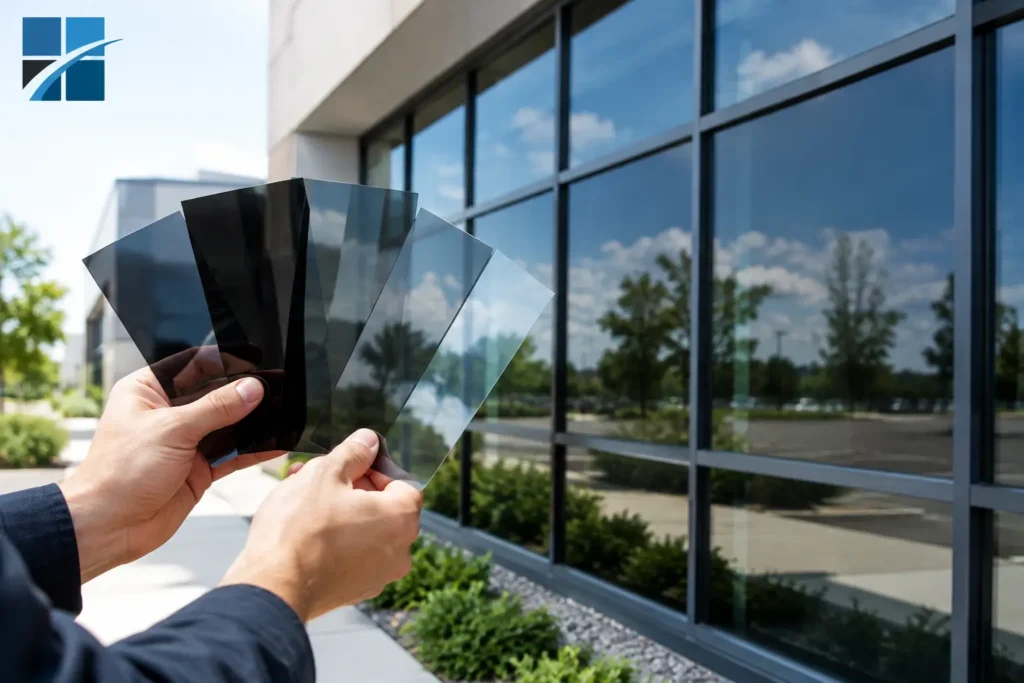
A south-facing office can look bright and welcoming at 9 a.m., then become the hottest, most uncomfortable part of the building by mid-afternoon. Glare makes screens hard to read, employees close blinds, and customers standing near storefront glass feel the heat. This guide to commercial window tint options explains what each type of film is designed to solve so you can choose based on your building, not just the darkest sample on a display board.
Commercial window film is a practical upgrade for offices, retail spaces, clinics, warehouses, schools, and multi-unit properties. The right product can reduce glare and solar heat, improve privacy, add a layer of glass retention, or update the look of interior partitions. The right choice depends on what is behind the glass, how the windows face, and the problem you need fixed first.
Commercial Window Tint Options for Common Building Problems
There is no one film that is best for every commercial property. A storefront that needs daytime privacy has different needs than a boardroom with glass walls or an office with high cooling costs. Start with the result you want, then match the film to the glass and location.
Solar-control film for heat and glare
Solar-control film is often the best starting point for businesses dealing with hot work areas, glare on monitors, faded merchandise, or uncomfortable customer seating near windows. These films reject a portion of solar energy while reducing visible glare and ultraviolet exposure.
Tinted, reflective, and ceramic films all fall under the solar-control category, but they do not perform the same way. A darker film may cut more visible light and provide stronger privacy, but darkness alone does not tell you how well it controls heat. Higher-performance ceramic or spectrally selective films can reduce solar heat while keeping the glass relatively clear. That can be a better fit for businesses that want natural light without the afternoon heat.
Reflective films provide a more noticeable exterior appearance and can offer strong daytime glare and heat control. They work well on some commercial facades, but they can change the look of the building and may create a mirror-like finish. Always consider landlord, condominium, or property-management requirements before choosing a highly reflective product.
Privacy and decorative film
Privacy film is useful when people need discretion without closing off a space. Frosted, etched-look, gradient, patterned, and opaque films are commonly installed on office partitions, meeting-room glass, clinic windows, reception areas, and washroom doors.
Unlike a dark solar film, decorative film is primarily about visibility and appearance. It can create a professional separation between spaces while still allowing light through. Frosted film is especially useful on interior glass because it keeps a room bright while preventing direct views into it.
For street-level businesses, privacy film needs careful planning. A dark or reflective finish may limit daytime views into the building, but the effect can reverse after dark when interior lights are on. If 24-hour privacy matters, an opaque or decorative solution may be more suitable than a standard tinted film.
Safety and security film
Safety and security films are designed to help hold broken glass together after an impact. They can be valuable for storefronts, entry doors, sidelights, schools, offices, and other locations where broken glass could create a safety concern.
These films do not make glass unbreakable. A determined impact can still break the pane, and film is not a replacement for proper locking hardware, alarm systems, or upgraded security glazing. What it can do is reduce the immediate scatter of sharp fragments and make a forced entry more difficult by keeping cracked glass together longer.
Security film performance depends on more than thickness. The glass type, frame condition, and attachment method all matter. For higher-risk applications, installers may recommend an edge-retention system that helps anchor the film to the frame. This is a situation where a site assessment is worth more than choosing a product from a sample chart.
Low-E insulating film
Low-E window film is intended to improve comfort across more than one season. It can help reduce solar heat in warmer months while reflecting some indoor heat back into the building during colder Alberta weather.
This option can make sense for offices and retail spaces with older windows where replacing the entire glazing system is not in the budget. Results vary based on the existing glass, window condition, air leaks, and the size of the window area. Film will not correct failed seals, damaged frames, or poor insulation around the opening, but it can be a practical part of a larger efficiency plan.
How to Choose the Right Film for Your Building
A good commercial tinting decision starts with the glass, not the colour. The same film can perform differently on single-pane, double-pane, tempered, laminated, coated, or insulated glass. Some combinations can increase thermal stress and raise the risk of glass cracking, particularly on windows with existing flaws or uneven shading.
Before installation, a professional should identify the window type, inspect the condition of the glass and frames, and consider how much direct sun the area receives. South- and west-facing glass usually sees the biggest solar load, while east-facing windows may cause intense morning glare. Interior lights, nearby buildings, and exterior overhangs can also affect the result.
Ask for performance information that relates to your actual concern. For heat control, look at total solar energy rejected and glare reduction. For fading concerns, ask about ultraviolet rejection and the role of visible light and solar heat, which can also contribute to fading. For privacy, ask how the film looks from both sides during the day and at night.
Appearance matters too. A film that looks neutral in a small sample can appear darker, bluer, or more reflective across an entire storefront. Viewing a larger sample against your building’s glass is the best way to avoid surprises.
Commercial Tinting Trade-Offs to Consider
Window film improves certain conditions, but every option has a trade-off. A darker solar film can reduce glare significantly, yet it also reduces daylight. A highly reflective film can improve daytime privacy, but it can alter curb appeal and may not provide privacy after sunset. Decorative film adds privacy indoors but will not provide meaningful solar heat rejection unless it is paired with a solar-control product where appropriate.
Safety film can help retain broken glass, but it is not automatically a code-compliant solution for every hazardous glazing location. Building requirements, fire-exit visibility, and tenant-improvement rules should be reviewed before work begins. If you lease your space, get property-manager approval in writing, especially for exterior-facing windows.
Budget also deserves an honest conversation. Standard dyed or metalized films may cost less upfront, while ceramic, spectrally selective, and specialty safety films generally cost more. The higher-cost choice may be worthwhile if it improves employee comfort, reduces glare on workstations, protects merchandise, or lowers strain on cooling equipment. The best value is the film that solves the right problem and is installed properly the first time.
What Professional Installation Should Include
Commercial film installation should begin with a clear scope of work. That includes which panes will be covered, the selected film, the intended finish, access requirements, and any work that needs to happen outside business hours to avoid disrupting customers or staff.
The glass must be cleaned carefully before the film is applied. Dust, adhesive residue, paint overspray, and damaged seals can affect the finish. After installation, the film needs time to cure. Small water pockets or a slightly hazy appearance can be normal during this period, especially in cooler conditions, and should clear as the moisture evaporates.
Once cured, clean tinted glass with a soft cloth and a non-abrasive cleaner. Avoid abrasive pads, razor blades, and harsh chemicals that can damage the film surface. Keep your warranty details and installation records on file, particularly for leased commercial spaces or properties with maintenance teams.
For businesses in Calgary, Airdrie, and surrounding communities, mobile service can make the project easier to schedule around staff, customers, and daily operations. JDB Autoglass can assess your commercial glass, explain practical film options, and complete professional installation with minimal interruption to your day.
The best commercial window tint is not always the darkest, shiniest, or least expensive option. It is the one that addresses the real issue at your windows – heat, glare, privacy, safety, or appearance – while working safely with your existing glass and the way your business operates.